Matilda the Musical - Lost in Adaptation
For my first article as our local musical fanatic, I wanted to showcase one of my personal favourites and explain how and why it works, by comparing Matilda the Musical on stage with the recent 2022 movie musical adaptation. This will be a spoiler-free review, going over some of the adaptation choices, regarding adaptation for intended audiences, and one of the biggest flaws that snuck in during the adaptation process.
Who is it for?
The original book by Roald Dahl was intended for kids, to see a little girl who loves reading, overcomes difficult situations, and wants things to be just. Putting her in a very unjust environment that gets resolved by the end, through compassion and a little smart problem-solving (and telekinesis). By this point, so many adults grew up on it, or at least the 1996 movie with Danny DeVito, that it’s become a staple even outside of those who read the book.
The stage musical adapted the book freshly, picking scenes that are iconic and mixing it with commentary on how kids are often treated, while creating a genuinely impactful story about child self-empowerment and adults still having to deal with difficult situations that can make them feel small. The vibes are immaculate and Matilda’s family, the Wormwoods, are ridiculous enough to bring a brighter atmosphere and add some adult humour, to balance out the frankly terrifying headmistress, the Trunchbull. A colourful and fun performance with a beautiful set, that can make kids and adults laugh and cry, which makes it a perfect family experience.
Then there is the movie musical. I don’t enjoy bashing things, and it did do some things well, like the singers being pretty decent, or some of the imagery during the song Quiet or Revolting Children, but oh does the adaptation struggle with who it is for. Opening with the words “To change the world it needs a little genius” is already a choice (TM), but I guess you can whittle the idea down from compassion and community to one special person fixing it all, even if it weakens the story’s moral. They cut essentially all of the adult commentary and jokes, reduced the Wormwood’s screentime and plot that added a lot of needed light-heartedness to balance out the school storyline, and weakened the connection between Matilda and her teacher Miss Honey by cutting a good chunk of her story. It feels like they wanted to make this a children’s movie and forgot what children are halfway through, making Matilda a hero protagonist with superpowers, rather than a little girl who is clever and can levitate a glass of water or some chalk. It’s a fine movie on its own, but you are missing so much, and it is a pretty poor adaptation.
I had to pause at certain points during the movie and just take in how the framing, combined with Netflix lighting, sometimes makes Matilda feel like a horror movie monster, with an exchange about the Trunchbull going verbatim
“I'm not scared of her!”
“You should be. She's dangerous.”
”So am I.”
Girl, you are five years old.
The Plot Thinnens
Let's first have a moment of silence for the characters we lost: Matilda’s brother and Mrs Wormwood’s part Italian dance partner Rudolpho. Admittedly Matilda’s brother in the stage version doesn’t add very much other than vague comic relief that gets uncomfortable when you realize that the joke is that he is portrayed as mentally disabled. I cannot fathom what led to this choice in the musical, and while getting rid of him gets rid of the unfunny joke, it does also take away from the Wormwood family dynamic. Matilda’s mom having a very loud hobby in dancing, while Matilda prefers the quiet, was a great way to show the differences between the family members when they aren’t actively interacting, especially when contrasted with Matilda’s favourite teacher, Miss Honey, visiting the same library as her.
Both of these got cut for the movie, and it made me wonder what else they cut.
The answer is: Lots of things! But this is where I run into constraints regarding spoilers. I don’t want you sitting here having me compare things you might not even know, so I’ll stick to some basic examples for now and promise that the same thing happens all over the place.
Using some early scenes that were famously in the older versions, Matilda messing with hair oil and putting glue in a hat, were both responses to things that Mr Wormwood did on stage in the musical. He’s a liar, boasting that everyone trusts people with good hair, so she ruined his hair for him, making the outside match the inside, mixing chemicals that were explicitly meant to be kept out of reach of children. That direct line from point A to B was missing, just like Matilda putting glue in his hat was a response to him telling her to glue a book to hers originally. It was robbed of context in the adaptation.
And that, my friends, is the key issue I have with the scripting of the adaptation. They kept all the big moments (important to specifically Matilda, other character moments often got cut completely), but it feels like they didn’t even know why the moments happened in the first place. The basic rules of setup and follow-through were thoroughly ignored. Chekhov would be disappointed.
There were only so many things I could say about this adaptation without ever touching on spoilers, and that 100% includes the music. So now go and listen to the stage musical, or look it up somewhere (TM) and get ready for a full spoiler music analysis in part two!
(Editor note: Part 2 of this article, with spoilers included, will come out soon!)
Written by Nic Treczoks, a dedicated Writing Committee member!
You can find Nic on Instagram: @nic_has_a_nac
Ibsen's First Steps
God was born small and crawling. Legendary Norwegian Henrik Ibsen, the second most performed playwright of all time after Shakespeare, went through at least 5 messy, derivative plays before he made something remotely worth considering. Or, at least that’s how the Great Narrative goes.
“Love’s Comedy,” Ibsen’s 8th play, is where the real fun starts. It’s the story of two guys who pursue two girls, one each. Falk and Lind, chasing Svanhild (named after a princess of legend) and Anna, respectively. Lind and Anna settle, all holy. Falk and Svanhild’s tryst unfolds differently. Falk’s a poet, an activist and… he’s looking for a muse. Svanhild marvels at his artistry a little, measures herself up. Measures him up, too. No, she tells Falk, I won’t be your muse, you can do your writing thing on your own. It’s liberation, really, abandoning the historic archetype relegation mechanism of all those artist types that wouldn’t just objectify you, they’d Generalize you, Mythify you, mutilate your personhood for the sake of metaphor. Enter: rich business guy. He tells Falk and Svanhild: your love will not last. The pair talk, really talk.
And decide he’s right. Crazy in love and utterly rational. Svanhild’s future is comfortable and miserable, by painstakingly conscious choice. Falk’s future is all about being out on his own, probably still doing his thing, pen and ink and tears and paper.
“Love’s Comedy” is widely considered to be Ibsen’s first real masterpiece. After it came “the Pretenders” (ignore that one), and then what is in my opinion the GOAT sequence of published plays. “A Doll’s House,” “Ghosts,” “Enemy of the People,” “Wild Duck,” “Romersholm,” “Hedda Gabler”. They’re all there.
So what was the darling protofeminist playwright’s deal before this historic run? Did he suck? Was “Love’s Comedy” a monumental pivot, a Beatles’ “Rubber Soul” moment?
When I started reading Ibsen’s stuff in order, it was from purely a completist impulse. I like diversity in my reading diet; I read, besides for fun, to expand my worldview and challenge my tastes. One day it hit me that maybe I was unfocused. Maybe I needed to really immerse myself in one particular author. Ibsen’s early works ended up serving both purposes. They gave me more focused insight into the Norwegian’s obsessions and quirks. They also proved challenging and taste-expanding.
It isn’t easy reading clunkily translated 19th century verse. It takes some time getting into a setting of 16th century Norway and its geopolitical conflict with Denmark. Most of Ibsen’s early plays are exactly like that – historical dramas with plots of nobles, feasts and poison. These are odd (in lieu of what I’d usually be reading; in terms of early 19th century play thematics they were probably not odd at all, maybe even crushingly standard) lyrical tragedies, more akin to awkward attempts at greek epics than the nuanced psychological drama of the later plays.
There’s some things Ibsen shed as he grew more refined. One striking element is a blatant Norwegian nationalism. In “Lady Inger,” he even tweaks historical events to stoke that anti-Denmark, pro-Norway sentiment. Norway comes out of the big battles stewing in the background of Lady Inger’s conflicted solitude as the noble, warrior force fighting the evil Danes and Swedes. It’s weirdly black and white. I think it’s sometimes alright to use less nuanced framing in campaigning for independence, and maybe that was his goal here. What’s even weirder, though, is that it just makes things up to play up the nationalism. It would have been alright if it was a wholly fabricated conflict, or perhaps if the setting was more fictionalized, but here Ibsen takes a real historical timeline (the Scandinavian Kalmar Union and the last attempts to maintain Norwegian independence within it) and changes its sequencing and choreography. A bit of alternate history that isn’t telegraphed or contextualized; in other words, historical revisionism.
It’s actually “Love’s Comedy”, again, that marks his first public reexamination of the straight nationalism of his early work. In edits to the text, he changed some words that were explicitly Norwegian to make the work more accessible to a Danish audience. This sparked a lot of hate from the more hardcore Norwegian nationalists that believed in the sacred purity of an essential Norwegian language.
Another thing he let go was verse. This he stayed with for longer, though, and his last verse play ended up being Peer Gynt, which is also coincidentally a thematic examination of various kinds of Norwegian nationalism. A lot of his early plays are in verse, and some are in prose, with random stanzas thrown in for no apparent reason.
“Love’s comedy” is in verse, and so is “Peer Gynt”. Verse seems to work for him in a few cases. Still, a more careful but unbounded approach to form is partly what makes Ibsen’s later plays so fantastic.
It’s not like he completely pivoted, though. Some of the cool things he does in his later plays are in the earlier ones too. Most notably, his obsession with strong women. In “Lady Inger”, the eponymous Lady Inger is deeply isolated as a noblewoman, simultaneously ostracized and pulling all the weight in a markedly patriarchal society. That theme of the isolation and confinement of women under patriarchy would go on to be reinterpreted in some of his best plays – “A Doll’s House,” a real classic, and “Hedda Gabbler,” that just got a lesbian movie adaptation starring Tessa Thompson as Hedda Gabler herself.
So what makes the later plays so much better? Nuance, for one. Critically facing his own nationalism and examining it in his plays. Writing as public therapy. Rearrangement, for another. His obsessions with patriarchy, class conflict, activist identity, heavy-handed symbolism, muses – these were all there in the earlier plays, it’s just that through revision, reconfiguration, playing with order and weight, he found how to make what was on his mind as impactful as possible on the page.
Reading Henrik Ibsen’s early work was sort of inspirational. And not because the plays were so interesting and idea-sowing. It’s precisely because they’re kind of stilted and obvious, these first awkward fruits of an undeniable tree, that they give me a sort of license to just play around. To feel what I’m interested in and create a silly, needlessly grandiose story out of it.
Written by Yan Nesterenko, a dedicated Writing Committee member!
You can find Yan on Instagram: @n_strenkyn
Theatre in Late-Stage Capitalism
Theater has always been a fragile art form. It requires lots of time, effort and a bunch of people willing to believe in a story together. In a world increasingly built for convenience and profit, that might be exactly why it still matters.
Written by Joy Roelandschap, a dedicated Writing Committee member.
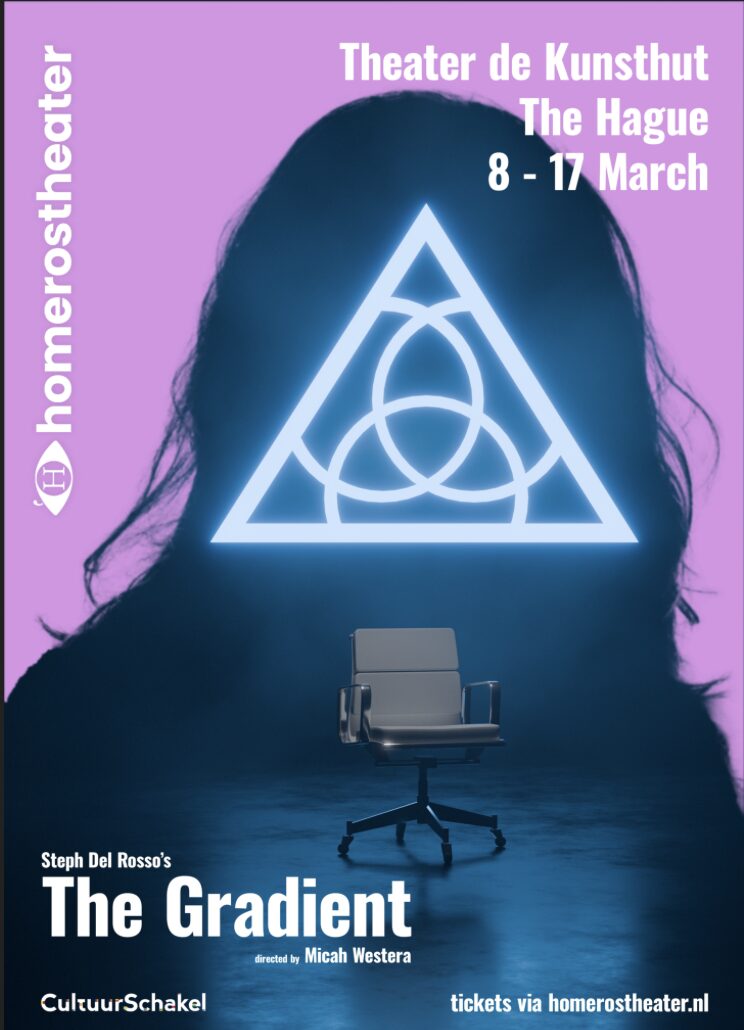
The Fifty Shades of Grey in “The Gradient”
"There is probably no genre more realistic than satire. If novel is a mirror carried along a high road, like Stendhal claimed, satire is a stone thrown at it to show you what’s hidden behind. And while it is depressing to admire your face in a shattered mirror, and it might bring you seven years of bad luck, it sometimes is just high time we stop staring at that piece of reality that is conveniently framed into what we feel comfortable examining. “The Gradient” is a stone that flies smoothly, almost deceitfully, and shatters your comfort zone slowly, piece by piece. It leaves you frustrated and uncomfortable. Wishing someone would hang that mirror back up there. Or a generic photograph that comes together with an IKEA frame. And it does all that in such a satisfying manner that you almost fail to notice.
Realism Behind VR Glasses
The feeling of frustration is not caused by the plot itself (however unbearable some characters are), as much as by the disappointing realisation that we’ve just witnessed the reality in which we find ourselves on a daily basis. The way the play was constructed enhanced this impression. It sometimes felt like we were spectating a regular conversation in an office, especially whenever Tess and Louis appeared on the scene together. Witnessing the development of their friendship gave me a sense of comfort, and was like an anchor of safety in the emotionally wrecking journey of the therapy sessions, Natalia’s disturbing speeches, and all the corporate crap. It was just necessary to shutter that seemingly working relationship, and Del Rosso did it with outstanding artistry. By making Tess do every mistake she worked on fixing in others.
“I know a thousand Jacksons” says Tess, and everyone in the audience puts an expression of solidarity on their face. We all know Jackson, we’ve met him hundreds of times. How does he manage to get away every single time then? How is he still a successful CEO of a tech company; someone’s boyfriend, husband, or a father; someone’s friend or a neighbour? And if we all feel about him the way Tess does, how does he succeed? The play doesn’t give us a hopeful outlook or a moral lesson. It almost feels like despite the main character’s powerful display of female rage, which is something I’d love to see more of in popular media, it is Jackson’s monologue that is the triumph. We can firmly believe that we deserve better than him, and that we are so much more than he could ever be, but somehow he still manages to figure out any algorithm that prevents him from getting what he wants. He knows exactly what values to put into equations that lead to a fast track to anything he lays his eyes on. This is what frustrates in that story.
The Clockwork Pink
If Jackson actually learnt about empathy, active listening, consent, and what makes a good apology, can we say he improved? Even if he doesn’t believe in it and uses this knowledge merely as a tool, he still shows desirable behaviours. And behaviour is the most objective way of measuring one’s psyche. Can we programme a good person? Is that concept ethically correct?
Tess’s burning enthusiasm about The Gradient quickly evaporates in order to leave space for the growing disagreement and doubt. She realises that math and science will only take you so far, but it is were conflicting interests of stakeholders, power plays, and human flaws come together that the real innovation takes place. The numbers don’t lie, unlike the patients. Natalia, just like her new employee, believed in the algorithm, but what makes her different from Tess is that she did not try to change the game and learnt to play by its rules instead. She certainly excelled in that art. She is actually a mirrored image of Jackson. She makes the algorithm, he is the one to crack it. He plays her game, but it was never hers to begin with. Tess wanted to kill them both, but they were the ones to kill her.
One of the most important monologues of Jackson was the one about a stir fry of sorry’s, however foolish it might have seemed. What he actually did was to accidentally (or perhaps very cunningly) reveal what The Gradient really is about – mass producing apologies and thoughtless patterns of behaviours. It is nothing more or less than cooking a big, greasy stir fry that will satisfy you for a day, and then give you a terrible food poisoning the day after. Even though the therapy was tailored to each individual, at the end of the day it was the same process for everyone. It was demonstrated in a spectacular way through having one actor play all Tess’s patients, and rapidly switch between them without any additional cues other than the different mannerisms, speech patterns, and body language. It was an impressive, attention-grabbing move that ultimately lead the audience to notice how little room for different shades of people The Gradient had to offer.
Some of the men, however, seemed to have actually realised their flaws. Their egotistical façade was broken through. But what is the next step? They did not work through their issues that let them to become insecure, self-absorbed, and so far detached from their own emotionality. Continuing their journey in a meaningful way after the release was, as Natalia said, a minority that reaches the media attention. For the rest of the wicked, all there was left was to leave a positive comment for the facility and go on with their lives with some more clearance, and a lot more confusion.
Crime and Punishment
I have hopefully showed by now that The Gradient talks about much more than sexual assault. It does, however, talk about sexual assault as well, and that topic should never be summarised with merely a meaningful moment of silence. We should speak about it, loud and clear, with confidence. I know it feels just right that the (female!) CEO of a facility that rehabilitates people charged with sexual misconduct is a prime example of victim blaming, but If there is one action to take after having watched the play, it is to make sure this is not what actually awaits us in the not-so-distant future.
“She remembers it every day. She thinks about it every time she has sex”.
Jackson, after hearing that, says: “I’m sure she’s moved on”. I, in my hopeful naivety, want to believe that he denies the truth because otherwise he could never look himself in the eyes again. That he tells Tess what his ex-girlfriend should hear because he would literally burn under her hollow look. That he was so happy and relieved after because the weight of his guilt has slightly lifted off his shoulders. That the image of a woman that accepts her fate instead of enjoying her first sexual experience is so engraved in his mind he can’t sleep at night. That this is the reason he was looking at his generic picture on the wall for hours. That’s the least Jackson’s ex-girlfriend and all the other women deserve. That those who shaped our understanding of sex as something to be ashamed of and to endure like a duty, at least feel bad about themselves. If not all the time, then at least half of the time. Or sometimes. We want to believe that them saying “I’m sorry you overreacted” or calling us a slut is the only way they can express that feeling. “I’m relieved”, says Jackson after hearing that the woman whose security he took away is doing fine. And yes, she is fine despite him, not without him. Relief is not meant for her.
The expression on Jackson’s face changed after Tess’s final outburst. Is it a look of remorse? Was he actually touched and at least felt bad for a moment? Would her words leave a mark on him? His response, if not prevented by the supervisor, could be a start to a dialogue. The only genuine and impactful dialogue in his therapeutic process, if not in the whole play. It takes courage to face your emotions and shout them out in someone’s face. Jackson’s ex-girlfriend would probably not have that courage. Luckily, Tess decided to not merely listen an apology not meant for her, but to also give a response in another woman’s name. Sadly, the algorithm did not teach him how to receive it and take something away from it.
Let Him Who Is Without Sin Cast The First Stone
The biggest question the play raises is “how are YOU fucked up?”. It is not just a funny gag or a way to engage the audience. It really is the essence of “The Gradient”. Nobody is black or white. We all are in the grey area, in one way or another. Natalia addressing us, the audience, is not a wink. It’s a slap in the face. And we take it with a laugh, but really we should cry. We applaud ourselves for not being rapists, but really we should whip our own backs for everything we are instead. Liars. Cheaters. Narcissists. Slaves of our own emotions. Jealous. Angry. Greedy. Full of self-pity.
What would be your score on empathy? How about introspection or potential for growth? We can only hope we’d get fast-tracked. We say we want to change the world, like Tess, but we have one true reason behind, just like she did – to achieve something; to feel fulfilled; better than everyone else. And what is a better way to feel good about yourself than to watch a play about evil people struggle to become any less insufferable? But we cannot just turn a blind eye on how the world has changed Tess. How it turned her from an ambitious, prosperous woman who talks to mice into someone capable of violence, struggling to maintain her own relationships, misinterpreting her coworker’s signals and failing to take responsibility for it. Her moral collapse is a more disheartening view than any of the men she gave therapy to. What is the worst part of it all, is that her biggest sin was not giving up in the fight against the senseless rules of the system governing The Gradient. Against the reality. She could have instead kept stacking clay until it falls, and then begin again. This is the only sin, however, that allows you to take the first stone and cast it. Cast it at a mirror that hangs in front of your face and shutter it to see what shade of grey you are."
Review written by Julia Kubiak, a dedicated Activities Committee member who organised this thrilling excursion to watch "The Gradient" by Homerostheater for WILDe's Members!
You can find Julia on instagram: @toreisvogel